Countdown to the Singularity
January 9, 2015
In 2013, researchers from RIKEN, the Okinawa Institute of Science and Technology Graduate University, and Forschungszentrum Jülich used Japan’s K computer to simulate a network of 1.73 billion neurons and 10.4 trillion synapses. The network represented roughly 1% of the network in a human brain, and it took 40 minutes to simulate one second of activity. Research announcement
That may seem rather paltry. But exponential growth has a way of making enormous gaps surprisingly small. How much more computing power would we need to run a network at human-brain scale in real time?
Forty minutes is 2,400 seconds. Running the same simulation in real time would require a 2,400-fold speedup. Scaling the network from 1% to 100% would require another factor of 100, assuming computational cost grows in proportion to network size. Together, that is a 240,000-fold improvement, or just under 18 doublings.
A doubling every two years would close that gap in approximately 36 years, putting the threshold around 2049. To see the progression, we can hold the network size fixed and spend each improvement on speed:
| Year | Computing improvement over the experiment | Time to simulate one second of the original network |
|---|---|---|
| 2013 | 1× | 40 minutes |
| 2021 | 16× | 150 seconds |
| 2029 | 256× | 9.38 seconds |
| 2037 | 4,096× | 0.586 seconds |
| 2045 | 65,536× | 0.0366 seconds |
| 2049 | 262,144× | 0.00916 seconds |
These are illustrative calculations, not measured simulation results. A network 100 times larger would take 100 times as long under the same assumption, reaching real time near the last row.
But is a doubling every two years realistic? Rather than relying on Moore’s law, which describes transistor counts, we can look at measured supercomputer performance.
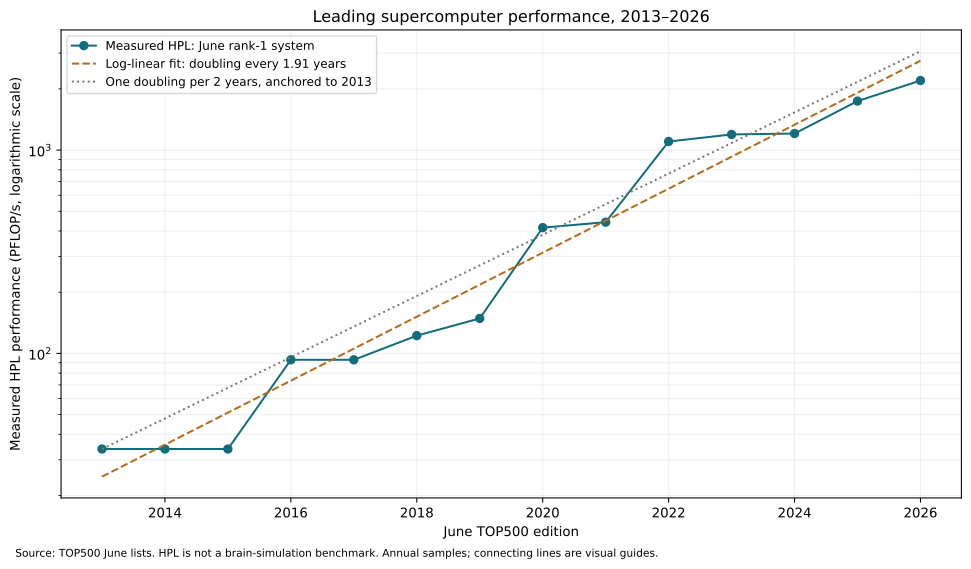
The chart uses the June TOP500 leader’s measured double-precision High Performance Linpack result for each year from 2013 through 2026. Performance increased about 65-fold over those thirteen years. That corresponds to a doubling every 2.16 years between the endpoints; fitting the full annual series gives 1.91 years. Progress comes in jumps and plateaus, but roughly two years per doubling is a reasonable description of this period.
And what about an entire human population? Take eight billion people as a fixed reference—the population milestone reached in 2022. Going from one brain-scale network to eight billion requires about 33 additional doublings. At two years per doubling, that is another 66 years: approximately 2115 for eight billion such networks running simultaneously in real time, at the same level of simulation detail. This holds the population fixed rather than predicting how many people will be alive then. Even so, the scale is extraordinary: a population’s worth of neuronal activity within roughly a century of the initial experiment.
Linpack performance does not translate directly into neuronal simulation speed. Memory, communication between processors, and better algorithms all affect the result. Nor does a network of the right size automatically possess human intelligence: the 2013 experiment used randomly connected neurons to test simulation technology. The date is a hardware extrapolation, not an appointment with the Singularity.
Still, the growth is substantial. Computers may surpass their makers in capability within the lifetimes of people alive today. We can only hope they will also surpass us in moral character.