The Other Half of the Holodeck
October 28, 2026
Overlore, and a small first step
When people imagine the Holodeck, they picture the room: the grid on the walls, the forest that appears around you, a table solid enough to lean on. Most work toward it—from VR headsets to game engines and haptics—goes into that half of the problem: showing a world convincingly.
But the Holodeck has another half, and it’s the more interesting one. Someone walks in and asks for Victorian London on a foggy night with a murder, and the computer invents it: the streets, the people, what they say. And it keeps inventing as they go.
The room is the display; the mind behind it is what makes it a holodeck. Overlore is a small first step on that second half.
The First Worlds You Could Talk To
Text adventures were the first worlds you could talk to. You typed GO NORTH, and the game told you where you were. Everything else—what the white house actually looked like, how the forest sounded, who you were—your imagination had to supply.
Overlore starts there, with the classics: Zork I, II, and III —games that proved a bit of text could conjure entire realms. I was always fascinated by them, and could never get very far.
As you play Overlore, the room you’re in is painted around and from the game’s text. Your own character sometimes stands in the picture — all rendered in classic 80s fantasy oil paintings, or pulp comic inks, or the green glow of an old terminal. And a dungeon master of your choosing tells the story aloud along with added commentary. The style of art is an option, and the commentary is invented on the spot.
Consistency Was the First Wall
Anyone who has used an image generator knows the problem. Ask for a knight in a forest, then the same knight in a cave, and you get two different knights. For a world that’s meant to feel real, that inconsistency is fatal.
It was our first major hurdle. What got us most of the way there was a reference image. You create your character at the start: you describe them by a set of fixed properties and, if you like, an embellishment of your own. Your portrait then becomes the reference for every later picture of you.
Rooms work much the same way: a room’s first picture is drawn with the neighbouring rooms already drawn as references, so the path through the forest looks like it leads somewhere you’ve actually been.
Is it perfect? No. In fact, you can see it slip in the game’s very first minute:
Zork I opens west of a white house “with a boarded front door” and a mailbox. That’s all it says, so that’s all the first picture shows:
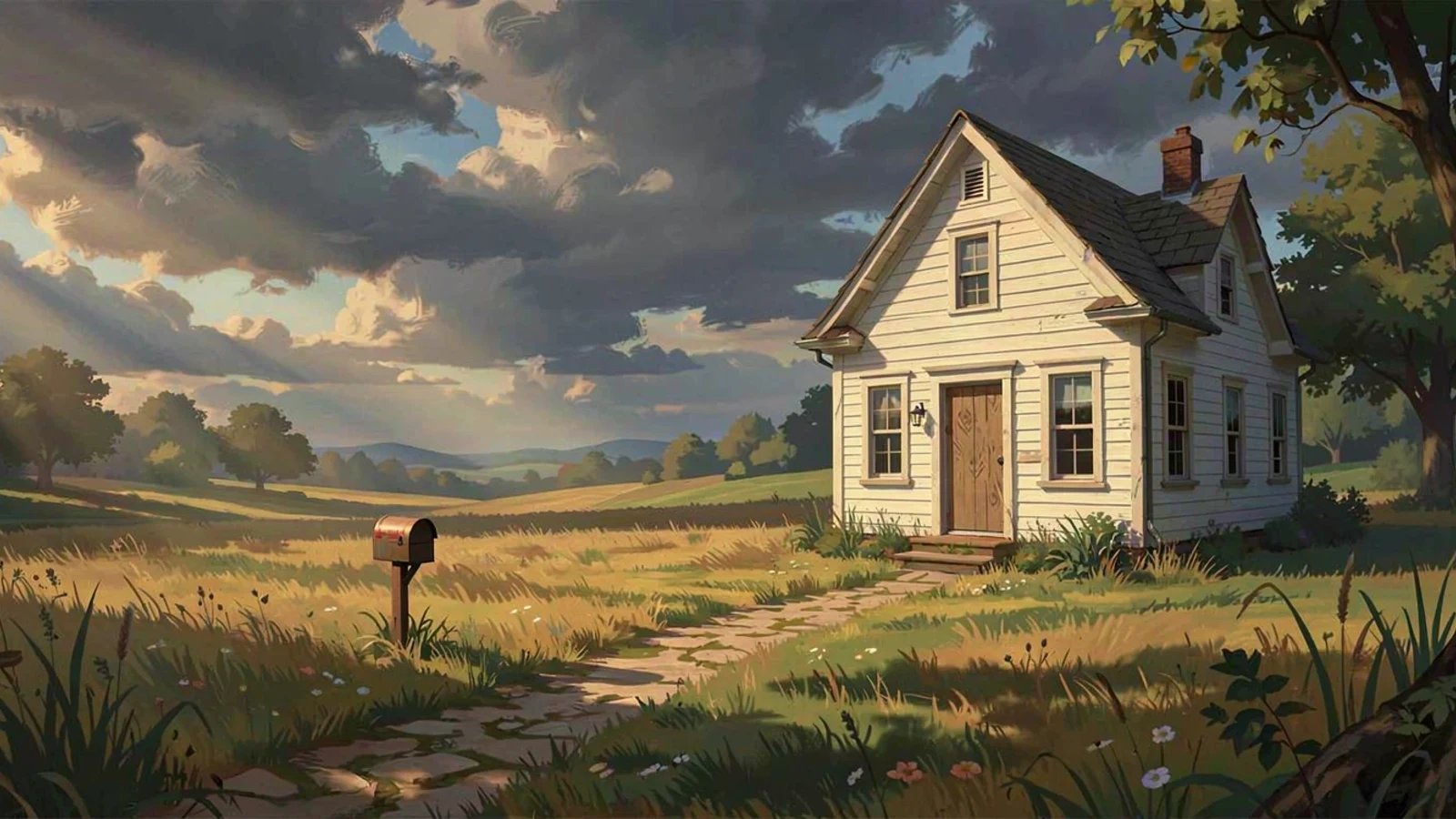 West of House, as the game drew it. The painter tried to have the door both ways: made of boards, but not boarded up.
Walk north, and the game tells you that all the windows are boarded up. Now the first picture is wrong. Or is it? The windows at the front were never mentioned. Should they have been boarded up too?
I think they should. A good illustrator reads the whole book before drawing the first page. The picture should show what someone standing there would see, given everything the game says about the place.
Invention Gets Cheaper as More People Play
Inventing everything, for every player, on every turn, would be slow and expensive. So Overlore remembers what it has made. Everything it generates is indexed by properties, but also meaning via semantic embeddings.
- Characters: When you describe a character, you’re first offered the closest matches from characters previously created. Pick one, and much of the art for your adventure already exists. You wait less and pay less.
- Customization: If none of them are right, you go fully custom. Because play is paid by use, custom simply costs more per turn.
- Voices & Narrators: Art styles and voices work like this too.
An embellishment makes your character uniquely yours, but you’re still shown the closest matches first, and thanks to semantic search, another player’s “uniquely theirs” might be close enough to “uniquely yours” to pick. If none are, yours is drawn fresh.
This is where starting with an established classic earns its keep. The game’s text is fixed, so its narration only has to be voiced once for each of the six dungeon masters. After that, it’s cached and reused for every player who reaches that room.
You can build a dungeon master of your own, too. Mine would be Cousin Buddy, who ran most of the few games of D&D I ever played. It’s one of the more expensive choices initially, since everything a new dungeon master says has to be voiced new. But like characters, dungeon masters join the catalogue: one day, someone else may pick Cousin Buddy off the shelf.
So the system has an odd property for an AI product: the more people play, the more of the world already exists, making it faster and cheaper for the next player.
Racing the Player
Overlore calls its image models cameras. The player picks which camera they want to use from a toolbar whenever they like.
“Shot on a cheap camera” is a charming thing to say of a comic, in a way “low quality” never is.
| Model / Camera | Est. Cost / Picture | Speed | Strengths |
|---|---|---|---|
| FLUX.2 Klein | ~$0.005 | ~9 sec | Affordable, charming baseline |
| Nano Banana 2 Lite | ~$0.035 | ~6 sec | Fastest speed across tests |
| Nano Banana 2 | ~$0.070 | ~12+ sec | Best character consistency |
(Note: Figures from early test batches; estimates, not final averages.)
Twelve seconds is a long time to wait for the next image. So caching matters as much for speed as for cost, and where nothing is cached, Overlore tries to get there first. When you arrive in a room, it speculatively starts drawing the rooms you might walk into next, so the picture is ready before you are.
The hard part is the game’s dynamic state. Zork’s thief wanders. Is he in the next room when you get there, or in this one? Does he belong in the picture being drawn ahead of you? A room drawn early can be wrong by the time you reach it.
The narration helps. While the dungeon master tells you about the room you’re in, there’s often time to draw the next one. It isn’t perfect, and sometimes you wait a moment for the picture.
Why Start From a Fixed Game?
There’s a reason to start from a classic game rather than letting an LLM invent the plot on the fly.
Worlds made of nothing but a language model tend to forget themselves: the door you locked is open again, the sword you carried is gone, and the story drifts. A classic text adventure is the exact opposite: a precise, deterministic world model with its own map, inventory system, and rules tested by decades of players.
In Overlore, the game engine keeps the world consistent, while the AI supplies what the game never could: what it looks like, who you are in it, and who is telling the story.
The dungeon master does more than read the game aloud, though. After narrating, it keeps up a running commentary, takes what you say into account, and answers you. Ask it how a jewelled egg could end up stuck in a tree, and it will tell you. I honestly have no idea what it will say. Neither does anyone else.
It knows a great deal about the game though. But it’s instructed not to spoil things. It offers a hint only now and then when you seem stuck, or when you beg. Which is exactly what I needed back in the 80s.
How much it gives is a dial controlled by the dungeon master’s disposition and your character’s intelligence stat. In most RPGs a higher intelligence is always a good thing to have–in Overlore it means the AI will offer you fewer clues.
When It Gets It Wrong
It does get things wrong. We’ve seen the white house rendered with two mailboxes in front, and heroes generated with an extra arm. (We fixed the mailboxes with a blunt instruction to the painter: each object named in the description must be drawn exactly once, unless it says there are more).
Some slips will always get through, so Overlore leans into comedy. From the very first screen, you’re greeted by a Bard who sells you the game like a used car salesman, another hiding behind a bush, and a parser with a dry wit. A world that’s in on the joke is far easier to forgive when the generative output stumbles.
Players also have a direct say: a picture they love can get an emoji, increasing the image rank in searches, while a flagged picture is retired back to the void.
Where It Goes Next
The boarded windows point to what comes next.
Today, the image painter works purely from the immediate room description. Instead, the AI could first digest the entire game code—gathering one coherent visual master-brief for every connected place: the house from every angle, the surrounding forest, the cellar. The original text remains what the player reads, but for the painter, it becomes a unified world-bible. Minus its secrets, of course: the trap door stays out of the picture until you move the rug.
The Holodeck in Star Trek was a whole fiction engine, and Overlore is a humble step toward it. But it starts on the half I find far more fascinating: not just rendering a world, but inventing it dynamically while keeping it real.
The gates aren’t fully open yet, but if you’d like an early look, a Bard is waiting at overlore.xyz. The Bards, their voices, and everything Overlore paints and says are made with AI.